Read: http://www.post-gazette.com/pg/06147/693671-84.stm
Psalm 2:1 "Why do the nations rage?"
Psalm 46:8-10 "Come, behold the works of the LORD, who has wrought desolations in the earth. 9 He makes wars to cease to the end of the earth; He breaks the bow and cuts the spear in two; He burns the chariots with fire. 10 'Cease striving and know that I am God; I will be exalted among the nations, I will be exalted in the earth.'" NASU
Mic 4:1-3 "And it will come about in the last days that the mountain of the house of the LORD will be established as the chief of the mountains. It will be raised above the hills, and the peoples will stream to it. 2 Many nations will come and say," Come and let us go up to the mountain of the LORD, and to the house of the God of Jacob, that He may teach us about His ways and that we may walk in His paths." For from Zion will go forth the law, even the word of the LORD from Jerusalem. 3 And He will judge between many peoples and render decisions for mighty, distant nations. Then they will hammer their swords into plowshares and their spears into pruning hooks; nation will not lift up sword against nation, and never again will they train for war." NASU
How long, O Lord? How long until You reign in peace?
Saturday, May 27, 2006

Thursday, May 04, 2006
The Future of the PC(USA)
I'm growing increasingly discouraged in my view of the Presbyterian Church (USA). At the Wednesday evening contemporary worship service on campus yesterday, Don Dawson preached about the need for a church to care about missions, lest it turn in on itself, collapse, and die. In firing over fifty of their missionaries this week, that is exactly what the PC(USA) seems to be doing to itself. The reason for the "budget cuts" of course is the shrinking numbers within the denomination. What's wrong in this chain of logic? "Our denomination is shrinking, so let's cut the programs that seek to evangelism." What?!
Secondly, there's the debate about the report from the Task Force on the Peace Unity and Purity of the Church. For non-Presbys out there, this report was commissioned a few years ago in hopes of creating some sort of definitive answer to the denomination's bitter intra-political debates. Neither liberals or conservatives are especially pleased with the PUP report, though, probably because it demands more time to discern the answers to the questions at hand. It does so by suggesting (idealistically) that the denomination remain unified while allowing its ordination standards to be applied selectively by each presbytery. In plain language, local groups of church would be able to ordain anyone (regardless of theology, sexual orientation, or other controversial issues) with no recourse from the national church.
At a lunch-time discussion of the report yesterday led by Dr. John Burgess, it became apparent that while the report may have the best intentions and might even be a solution in an idealistic world, in reality it will do more harm than good. Whether it passes or fails at this summer's General Assembly, people will be upset and will surely talk about splitting the denomination.
It is times like this that I am thankful that I've always identified myself as a Christian first and a Presbyterian second. My faith is in Christ alone, regardless of what comes of the denomination I happen to be a part of now. In all honesty, I felt called to serve within the Presbyterian Church specifically because of all that is wrong in it now, and that's why I'm at a Presbyterian seminary now. Now the question is whether or not there will be one denomination, two, or several for me to choose from when I finish school.
Without speculating about the answers to those questions now, I will simply say that I'm thankful for the emergent church movement and what it's doing to transcend these downfalls of denominationalism. I'm grateful for the Open Door and the other like-minded churches and people here. Whenever I wonder why God called me to leave Colorado and come to seminary in Pittsburgh, The Open Door is the first answer. In a post-denominational world, churches who 1) care about following Jesus in both word and deed and 2) will actively engage their culture and surroundings to do so will surely be the most "successful."
Sunday, April 30, 2006
"Illegal Immigration" and American Inhumanity
As the immigration debates have heated up in national politics recently, I've noticed a disturbing inhumanity in the language used to talk about these people. Let me emphasize the word we should use: people. I grew up in a small town in Colorado with a relatively high number of immigrants from Mexico in its population. My high school friends used to joke about them. For example, in an American History class our teacher started listing statistics. After she gave the number of illegal immigrants living in Western Colorado, one student whose family owned a fruit ranch near town interjected, "And half of 'em work for me!"
I had a few Mexican friends in high school, but for the most part stayed within the boundaries of the social segregation that was assumed in my hometown. After finishing school at the University of Colorado, though, I worked in a grocery store where half of my coworkers were Mexican, and many, if not most, of them were undocumented immigrants. Through the little bit of Spanish I learned in high school and the little bit of English they learned in the workplace, we talked, learned each others' stories, and came to share profound amounts of respect for each others' lives.
One of my supervisors had worked multiple fast food jobs, supporting a wife and kids on that thin wage for over a decade before finally getting the better job at our grocery store. Another man never learned much more English than "how can I help you" and "thank you very much", but was the hardest worker in the department and supported his wife and kids on that slim wage as well. Yet another man sought to continue climbing the ladder by applying for a promotion to "coffee-specialist", and even though he knew the job and the product inside and out, couldn't get the job because he didn't speak enough English.
Then came the month where the store did a "social security audit" verifying the SSNs of all their employees. Some numbers, of course, came back with problems. To protect the company, many of my friends were let go gracefully, given two months to find another job rather than being fired immediately. The man who was my trainer told me with tears in his eyes, "We all know this happens. It is sad. But we will find other jobs." He started looking for work in construction, others went to landscaping, and still others back to fast food. Their lives were uprooted, the relationships they'd built destroyed, and their years of hard work wiped away.
Seeing their pain and their struggle, their efforts to make a living, to provide for their children, and still have money to send back to family in Mexico, makes an impression. It is easy to talk about "illegal immigrants" the way the newspapers do. But when you're talking about mis amigos de esa tienda de abarottes, you realize they are real people.
Maybe that's why I got so upset with the "letters to the editor" in the newspapers today: A previous article in the Pittsburgh Post-Gazette had pointed out that our European ancestors were illegal immigrants when the Mayflower washed ashore. An astute point. Today a local woman responded by writing "The [Native] culture was nearly destroyed in the process and thousands were killed through disease and a genocidal cleansing of land. . . . We should remember what happens to a people who don't [sic] control their borders to illegal immigration." Grammatical idiocy aside, this woman was insensitive enough to suggest that these people would bring disease and genocide to American culture! Another example: In a recent letter to the editor in my hometown newspaper, The Delta County Independent, a man likened immigrants to "a truckload of worms that has been progressively multiplying for decades."
Immigrants are not worms. They are not here to destroy our country. They are here because they are real people, seeking real ways to support their families, and trying to give their children a better life.
Now add to this basic human right the theological truths that we Christians believe: Abraham was an alien in a foreign land, as were the Israelites in Egypt and later in captivity in Babylon. In the Incarnation, Jesus Christ came as a foreigner to our level of humanity. Since Christ came, Christians have recognized that we are all aliens in a strange land, not at home until we arrive in heaven. We are, in St. Augustine's terms, the City of God dwelling within the City of Man. The letter of First Peter opens by calling us "strangers in the world". How can we, strangers in the world, blessed by the immigrations of our spiritual forbearers, deny justice to immigrants in our own nation today?
Think on the words of Malachi 3:5 (NIV): "So I will come near to you for judgment. I will be quick to testify against sorcerers, adulterers and perjurers, against those who defraud laborers of their wages, who oppress the widows and the fatherless, and deprive aliens of justice, but do not fear me," says the LORD Almighty.
Wednesday, April 19, 2006
How God is Challenging My View of Academia (Poverty Part 3)
Thank you to my good friend Randy for the thoughtful comment in response to my last posting. Randy always has a way of speaking truth directly and forcefully, as seen in that comment. Recognizing that Jesus' words about riches, wealth, and the blessings of the poor have to do with a lot more than just spending our money wisely, it's time to ask, 'what else can we do to live up [or down] to what Jesus calls us to?'
Right now I'm reading a book by Shane Claiborne called The Irresistible Revolution. Shane is one of the founding members of a Philadelphia-based inner-city ministry/community called The Simple Way (http://www.thesimpleway.org). Fed up with the insulation of white Christian suburbia, Shane and some friends started going on regular trips to the inner city to have fellowship with a group of homeless families who lived in an abandoned church. Notice the choice of words there: they went for fellowship. The only mission they were on was to help protest the forced eviction of these families, but by taking on the literal role of Jesus in spending time in fellowship with them, they ended up falling in love with everyone there and making fellowship with those people a regular part of life. Eventually, they succeeded in preventing their eviction, with the help of several answers to prayer. The book conveys the power of the story much more than any summary I write can, so I certainly recommend it. What I can say, though, from having read a third of the book, is that I have been moved almost to tears several times while reading it because I see him doing ministry and making a difference in the world while I'm sitting here reading about it and "studying to do ministry".
Theology is important, no doubt, but there comes a point when scholarship insulates us from Jesus' calling in the same way that riches do. For example, take the difference between Matthew's version of the beatitudes and Luke's: "Blessed are the poor in spirit" vs. "Blessed are the poor." While I bet Jesus did mean to bless those who are grieving, mourning, and depressed, I've heard numerous people write off this blessing of the poor implying that Jesus only meant those who are poor in spirit. If we believe he only meant the poor in spirit, it's easy to start thinking that it's fine to be wealthy and miserly, all as long as we recognize that Christ meets us in our emotional sorrow.
That is, of course, a load of crap. But that's exactly what we feed ourselves when we start rationalizing away the brazenness of Jesus' message. This morning in Exegesis, Dr. Gagnon talked about how Jesus' words "Eat my flesh, drink my blood" were intentionally offensive because they were meant to call attention to his exclusive saving power. What do we do with that in church today? Call it symbolism and then forget what it symbolizes, namely the fact that Jesus' himself is The source of life.
So now I am left wishing that I was getting more real tangible experience in ministry right now - both to the poor in spirit and to the just plain poor. That is what my field education will provide in one aspect next year, but since I'll be working at a fairly well-off suburban church, I'll surely still be wrestling with these distinctions. Until then, I still admit that I'm not living up to Christ's calling here - I only pray that God will have mercy upon me until I actually do.
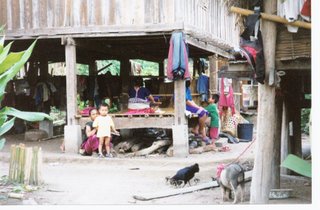
Parting thought: in the summer of 2002 I spent two months in Chiang Mai, Thailand. Living in the city, teaching English to college students, we met people who were mostly in the top ten percent of the country economically. Even so, we ate meals that cost only fifty cents each, standard fare for a full plate of rice, veggies, and some meat. Two weekends we traveled out to the rural villages to visit the people who work mostly as rice farmers. There the kids rarely get more than a third grade education and are lucky if they don't either go to jail for growing marijuana or become teenage prostitutes in the tourist areas in southern Thailand. Here's a picture of a typical family. We were some of the first Americans they saw and also some of the first Christians. What sort of message did we convey by showing up with all our digital cameras and multiple sets of clothes? Is that the Gospel? How could we have better represented Jesus to them?
Right now I'm reading a book by Shane Claiborne called The Irresistible Revolution. Shane is one of the founding members of a Philadelphia-based inner-city ministry/community called The Simple Way (http://www.thesimpleway.org). Fed up with the insulation of white Christian suburbia, Shane and some friends started going on regular trips to the inner city to have fellowship with a group of homeless families who lived in an abandoned church. Notice the choice of words there: they went for fellowship. The only mission they were on was to help protest the forced eviction of these families, but by taking on the literal role of Jesus in spending time in fellowship with them, they ended up falling in love with everyone there and making fellowship with those people a regular part of life. Eventually, they succeeded in preventing their eviction, with the help of several answers to prayer. The book conveys the power of the story much more than any summary I write can, so I certainly recommend it. What I can say, though, from having read a third of the book, is that I have been moved almost to tears several times while reading it because I see him doing ministry and making a difference in the world while I'm sitting here reading about it and "studying to do ministry".
Theology is important, no doubt, but there comes a point when scholarship insulates us from Jesus' calling in the same way that riches do. For example, take the difference between Matthew's version of the beatitudes and Luke's: "Blessed are the poor in spirit" vs. "Blessed are the poor." While I bet Jesus did mean to bless those who are grieving, mourning, and depressed, I've heard numerous people write off this blessing of the poor implying that Jesus only meant those who are poor in spirit. If we believe he only meant the poor in spirit, it's easy to start thinking that it's fine to be wealthy and miserly, all as long as we recognize that Christ meets us in our emotional sorrow.
That is, of course, a load of crap. But that's exactly what we feed ourselves when we start rationalizing away the brazenness of Jesus' message. This morning in Exegesis, Dr. Gagnon talked about how Jesus' words "Eat my flesh, drink my blood" were intentionally offensive because they were meant to call attention to his exclusive saving power. What do we do with that in church today? Call it symbolism and then forget what it symbolizes, namely the fact that Jesus' himself is The source of life.
So now I am left wishing that I was getting more real tangible experience in ministry right now - both to the poor in spirit and to the just plain poor. That is what my field education will provide in one aspect next year, but since I'll be working at a fairly well-off suburban church, I'll surely still be wrestling with these distinctions. Until then, I still admit that I'm not living up to Christ's calling here - I only pray that God will have mercy upon me until I actually do.
Parting thought: in the summer of 2002 I spent two months in Chiang Mai, Thailand. Living in the city, teaching English to college students, we met people who were mostly in the top ten percent of the country economically. Even so, we ate meals that cost only fifty cents each, standard fare for a full plate of rice, veggies, and some meat. Two weekends we traveled out to the rural villages to visit the people who work mostly as rice farmers. There the kids rarely get more than a third grade education and are lucky if they don't either go to jail for growing marijuana or become teenage prostitutes in the tourist areas in southern Thailand. Here's a picture of a typical family. We were some of the first Americans they saw and also some of the first Christians. What sort of message did we convey by showing up with all our digital cameras and multiple sets of clothes? Is that the Gospel? How could we have better represented Jesus to them?
Friday, March 31, 2006
More Thoughts on Apostolic Poverty
My good friend Jimmy from Colorado posted a very thoughtful response to my last post, which leads to this revision/continuance of what I had talked about. To view his post, just scroll down and click on the comments to my last one. In summary, Jimmy made some great points about 1) how the parable of the talents in Matthew 25 suggests that what we do with our money matters more than what we have, 2) how Richard Foster wrote in "Celebration of Discipline" that God doesn't want us to be either rich or poor (because the extremely poor can be just as preoccupied with money as the wealthy), 3) and the education of Paul is evidence that he came from a wealthy background. I'm sure that all of these ideas are true, but I still think we need to add a couple qualifications to them. While I think Jimmy is exactly right that God gives us economic blessings so that we may be blessings to others, I think there are subtle ways in which we often fail to use that money appropriately.
First think about it this way: in order to have wealth, you have to acquire it. Regardless of what one does with his/her money, doesn't God also care about how that person got the money? Check out Deuteronomy 23:18: "You must not bring the earnings of a female prostitute or of a male prostitute into the house of the LORD your God to pay any vow, because the LORD your God detests them both." (NIV). Obviously prostitution was then and is now considered to be immoral and offensive to God's design of sexuality, hence profits made from that were not acceptable to God even if someone tried to present them as an offering to God. Now let's apply this to today's business world. Of course there are many perfectly honest companies and executives out there, but we know there are just as many who are not perfectly honest or faultless in their business ethics. If it is acceptable in God's sight to possess wealth, does that hold true for people who made their money in the tobacco industry? Or the pornography industry? Or drugs? I have a feeling God detests those products like God detests prostitution. So what about companies that are economically immoral? Most people agree that sweatshops amount to cruel treatment of the workers. Would God approve of the wealth possessed by a person who made his/her money by marketing merchandise made in sweatshops? Furthermore, does God approve of us buying clothes that are made in sweatshops because we want to save the extra money to include in our tithe at church? The lines there are getting pretty blurry.
This leads to the second point: even if we received our wealth justly and honestly as a blessing from God, are there moral implications for how we go about preserving that wealth? Let's use coffee as the example now. "Fair Trade" coffee hit the market after people read horror stories about the way workers on coffee plantations in Africa and South America were abused and not even paid enough to live on. (For more info, see http://www.globalexchange.org/campaigns/fairtrade/coffee/). If my need for caffeine forces me to buy cheap coffee and thus perpetuate the degradation of a worker in a third-world country, does God approve of that? I don't think so. What if I need the coffee to stay awake to study for my seminary classes? I still don't think God would approve. One of the core themes in the Old Testament Prophets is that economic exploitation is dishonoring to God. Therefore, while it may have been acceptable in God's eyes then for people to possess some degree of wealth (the kings of Israel?), it wasn't acceptable if that meant the oppression of others. Here is one final example that carries this idea one step further: God created the earth and said that it was good, and even though God gave us dominion over the earth, he probably didn't intend for that dominion to lead destruction of his good Creation. When we buy food that was grown using pesticides that pollute the ground, we are polluting God's Creation. When we buy other products that are made in a manner that demeans Creation, such as non-recycled/recyclable materials or gas-hogging vehicles, we are also polluting God's good Creation. And why do we do these things? Because we love our money too much to pay the premium for a hybrid car or organic food. And of course this doesn't even scratch the surface on the even larger issue of moral investment/divestment. If we put our savings in mutual funds or stocks that include companies that are unethical in their business practices, are we too not responsible for their sin? When Sharon Watkins, the Enron "whistle-blower", gave a guest lecture here at Pittsburgh Seminary last Fall, she mentioned the fact that responsible investment is one of the only ways to hold unethical companies like Enron responsible. If we divest the savings we have in immoral companies and instead invest them in socially-responsible companies, we send the powerful message to business executives that we value people and morals more than just money and interest.
I write all these things realizing that I am far from perfect in living up to these standards. Most of the ideas I listed above are ones that I am only now beginning to explore in terms of actually making a difference in the way I live. But that is what it means to repent - when we realize we are in sin, we repent, turning the other direction and making a difference in our lives. In sharing these thoughts, I guess I am initiating the repentance process for myself, which for now may just be a heightened awareness of the impact my decisions make. The more people there are who have the awareness, though, the more people who will make a change in their lives, and that has the power to change our society.
Holy Lord God, please help us, though we fail to live up to Your perfection, to at least live in a way that pushes us ever closer to You. Forgive us our oppression of others, and grant us the ability to see the economic decisions we make through Your eyes. If You bless us with wealth, guide us by the power of the Holy Spirit to show us how to manage and use that wealth as You alone see fit. Amen.
Tuesday, March 28, 2006
Thoughts on Apostolic Poverty
"Rich or poor, God I want You more than anything that glitters in this world. Be my all, all consuming fire." - Charlie Hall, All We Need -
Rich or poor. Emphasis on poor. On the phone tonight I had a chance to catch up with my best friend from college who told me about his recent feelings of conviction about his own selfishness and materialism. Providentially, since getting married and moving to Pittsburgh, Eileen and I have tried to live our life here together in a non-materialistic way. Tried because we have not always succeeded - a la the deluxe coffee table we have courtesy of Eileen's parents. But there have been some successes. For example, as I'm typing this, I'm wearing a shirt I bought at a thrift store and pants given to me by a friend. Beans and rice were lunch today. And after paying the copay at a doctor's office today I was left with a grand total of ninety-five cents in my checking account.
At the beginning of the semester Professor Scott Sunquist frequently reminded our Church History 1 class about the continual importance of apostolic poverty for the early leaders of the church. Athanasius, St. Patrick, Columbanus, and many more boldly set the examples for what poverty meant in conjunction with the Gospel. At the same time as I was hearing this in class, Eileen and I were getting involved at The Open Door - the most unpretentious and genuine church I've ever attended. The sermons may not make a big deal about it, but it is obvious from the fact that we meet in a cold and drafty old church building currently under renovation that the community of The Open Door embodies more genuinely the virtues of apostolic poverty than any other non-monastic church I know. Add to that the connection with the intentional communities associated with the people of the Open Door who move into the poorer parts of the city for the sake of setting a Christ-like example for their neighbors. Perhaps that community is more sensitive to the riches of poverty because of their own personal experience as well: as a tangible reminder to pray for the concerns of people in the community at church a couple weeks ago, people were invited to write their personal prayer concerns on a rock which would then be taken home by another person who would commit to pray for that concern and person. Right now I'm looking at a rock that reads "failure, poverty, and debt". I can relate to the debt - I graduated college with credit card debt and no job, and that debt was eventually only relieved by the generous wedding gifts we were given.
Perhaps this is why "debt" in the Calvinist tradition is so often used as a metaphor for sin: it is a pit we simply can't get out of on our own. And just as in realizing our spiritual poverty we are forced to come to God for His gracious cancellation of our debts, our physical poverty in this life serves as a tangible reminder of our ever-present need to depend upon the Lord.
So where does this lead? To the lyrics of Derek Webb's song, Rich Young Ruler. (http://www.derekwebb.com)
"Poverty is so hard to see when it’s only on your tv and twenty miles across town,
where we’re all living so good that we moved out of Jesus’ neighborhood,
where he’s hungry and not feeling so good from going through our trash.
He says, 'More than just your cash and coin I want your time, I want your voice. I want the things you just can’t give me.'
So what must we do? Here in the west we want to follow You.
We speak the language and we keep all the rules (even a few we made up).
'Come on and follow me, but sell your house, sell your SUV, sell your stocks, sell your security
and give it to the poor.'
'What is this, hey what’s the deal? I don’t sleep around and I don’t steal.'
'But I want the things you just can’t give me.
Because what you do to the least of these my brother’s, you have done it to me
because I want the things you just can’t give me.'"
May God grant us the grace and ability to live up to what these words suggest.
Monday, March 20, 2006
This morning I read some words of Jesus that really struck home for me. In Mark 10:29-30 (NASB) , Jesus says, “Truly I say to you, there is no one who has left house or brothers or sisters or mother or father or children or farms, for My sake and for the gospel’s sake, but that he will receive a hundred times as much now in the present age, houses and brothers and sisters and mothers and children and farms, along with persecutions; and in the age to come, eternal life.” To come to Pittsburgh, Eileen and I left behind all the friends we'd made in Boulder, CO, and our families in Colorado, Chicago, and Phoenix to come here so I could attend Pittsburgh Theological Seminary. At the time I didn't think the distance from friends afamilyliy would affect me much - I seemed to believe that emotional attachments like that didn't have as big an effect on me. Eileen took it harder, and even though she's done a better job of keeping in touch with friends in Colorado, she still misses Boulder even more than I do.
Yet now we are anything but lonely here in Pittsburgh, and this past weekend testifies to how much our new family here has grown. Friday we had a St. Patrick's Day party with friends from the seminary, the Open Door, and others, and we were blessed by the presence of every one of them in our apartment that evening. Saturday night BJ and Katrina Woodworth welcomed us to their house to hang out and chat, graciously including us in their family's birthday festivities for BJ. Then last night at the Open Door, it really sank in how much the community there has become an essential part of our lives. As John Creasy preached about how we have been "adopted" into the family of God, I saw how that process becomes tangible in the new church communities we join.
Jesus is faithful, and his words are true. Of course that shouldn't be a surprise, but it can be surprising at times to read in the Gospels something Jesus taught two-thousand years ago, and suddenly have it dawn on you how true it is in your own life. Praise be to God for the families we've been blessed with both at home and here in Pittsburgh. May God grant us the ability to continually live as a part of God's family: "Jesus said to them, 'My mother and My brothers are these who hear the word of God and do it.'" (Luke 8:21). Amen.
Monday, March 06, 2006


poesistheou?
What do I mean by poesistheou? The inspiration for this blog title actually goes back to a class I took at the University of Colorado. One of my majors there was Creative Writing, and I remember a day where my poetry professor explained the etymology of the word poetry. Poetry has its root in the Greek word poesis, which means the process of doing, making, or being in action. When a person write poetry, he or she is using words as building blocks to create something, a linguistic work of art that acts upon the reader/listener. So, poetry is quite literally the process of doing language.
That said, as a seminary student who still tries to write poetry, I've noticed especially this year that there are some aspects of God that can only be described in poetry, song, or art. A professor here named Scott Sunquist likes to point out the importance in church history of people who "sing their theology". As systematic as we make it, some things about God can't be confined to black and white prose on a piece of paper. So one aspect of poesistheou is that it's about dealing with God, thinking about God, talking about God, relating to God poetically, musically.
The other side of poesistheou is that because poesis basically means action, I want to try to be aware of God's action in this world. As I've grown out of the shallow faith I had in high school, I've come to see that God is more at work in this tangible world around us than we can ever imagine. Being religious isn't only about believing, it's about acting on that belief. So, the idea of poesistheou ends up being not just how we think about and believe in God, but how we act. It includes how we interact with God, with other people, and how we see God acting in this world. God is real, active, and beautiful in ways that are beyond comprehension - that is what I mean by poesistheou.
Subscribe to:
Posts (Atom)