The past two weeks have been packed for Eileen and me, hence the lack of new posts during that time. Everything that has happened, however, is significant, so here's a quick overview of what God's been doing in our lives:
1) Moving. As of July 22, we no longer live in the Seminary's apartments. That day, with the help of a few friends from the Open Door and from the Seminary, as well as with a U-Haul truck four times bigger than necessary, we moved into a house in Garfield, a neighborhood just a few blocks away. The owners of the house are Kendall and Jen Pelling, and we are renting a bedroom from them while sharing a kitchen, living room, and dining room. The house is over a hundred years old but feels almost brand-new thanks to Kendall's remodeling expertise. There are two reasons why we're doing this: a) It's a chance to live in Christian community, sharing possessions and space with each other the way the early church did. There are many other Christian communities doing this in America's cities and inner-cities today (Simple Way), and while the house probably won't take on the monastic flavor that others have, it will be an amazing experience. I don't know how God will change us during this time, but as our lives together take shape, I pray that Christ will be glorified and that we will all become more like Him through this time. b) This is the first time Eileen and I have lived in a mostly African-American neighborhood. A distinctive mark of similar Christian communities which I mentioned above is a passion for racial reconciliation, manifest in moving into neighborhoods that other white folks might not. This will also be a new experience, but priceless, I am sure. Praise God that now after talking/blogging here and there about problems of racism in Pittsburgh, I get to walk the walk.
2) Yesterday was our first anniversary! Praise God for a year of love, growth, and joy. Of course there were rough spots, but Eileen and I would both surely say we've grown through them. To celebrate, Eileen and I took off to Faith Mountain, a retreat center for pastors in the middle of rural West Virginia. Our weekend there was amazing as we enjoyed the beautiful mountains of WV, hiked, explored the small towns nearby, and spent time reconnecting with God and each other. Once we have pictures available, I may post a bit more about that trip, especially the bizarre looking turtle we stumbled upon while hiking.
3) Right after we returned from WV yesterday, we went to the Open Door where we participated in a special prayer time for Amara and Emilee, two young women whom we were blessed by every Wednesday in our weekly Bible study at the Open Door. They are each leaving Pittsburgh, both to New York state, though for different callings. Saying goodbye to them at the Creasys' house last night made me think about how the composition of the Open Door will change this year. Even as Eileen and I become a bit less involved there so that I can pursue field education at Northmont United Presbyterian Church, I know part of my heart will always be with the folks at Open Door. I have encountered no community like it who as a church embodies what it means to be followers of Jesus. I'm grateful for all the encouragement they've given me this year and look forward to seeing what God will do in the future there.
So with moving, church busy-ness, and the celebration of our first anniversary, it's obvious that a lot is happening in life. I hope to post more about the insights and lessons that I learn in the coming months. Praise God for his faithfulness and life in Christ!
Monday, July 31, 2006

Monday, July 17, 2006
A Response to Backwoods Presbyterian Part 2
To Backwoods Presbyterian: Thank you for your willingness to share your own experiences of poverty in rural West Virginia. You have some great ideas and I appreciate the perspective your travels around the world brings, but there are two things I must clarify.
One: Your comments seem to accuse me of just wanting to "throw money" at the problem of poverty. First, I've been addressing the attitudes of wealthy Christians, not suggesting particular political agendas or proposed solutions to poverty. I certainly realize it's not that simple and recognize that much has to change in the mindsets and attitudes of some people living in poverty. Being new to Pittsburgh and new to urban environments myself (I come from a small town where homelessness is unheard of), I don't have the experience or vision yet to know how to change the people affected by poverty. What I do know, however, and what I hope to convey in my blogs about this subject is that as followers of Jesus Christ we are called to avoid greed like the plague. I believe that a great deal of poverty is in fact caused by greed (i.e. the stealing of aid-funds by governments in countries you mentioned). However, if we are followers of Christ, we too must watch out for greed in every aspect of our lives. That America has become an icon for the idolatrous religion of the wealthy is what I mean when I say we are complicit in the problem. Would Jesus be pleased by business people making millions upon millions of dollars in unjust ways? Of course not, and yet some churches are filled with those very people. If I may be bold, I will say it is inexcusable for a person who claims to be a Christian to become wealthy. Why? Because Jesus told his followers, not just the rich young man, to sell their possessions and give to the poor. Because our material comforts lull us into a spiritual sleep (think of Christ's words to Laodicea in Rev. 3:14-21 - they're wealth distracted them from worshipping God). And because God cares about economic justice (all the Prophets).
Two: You seem also to assume that racism does not exist in America today and is not at least somewhat to blame for the problems facing inner-city minorities and immigrant communities. This winter, an incoming student here at PTS told me about an encounter she had with a local realtor: Moving here from another state, she contacted this man to look at houses in the area of the seminary. When she told him her price range, he responded with "Oh, if you have that money then you don't want to live down near all those black people." Little did he know that she was African-American. It's not a violent example, so it would never get in the newspapers, but it shows how this subtle racism works. The man automatically assumed that a woman with that much money could not be black. It's that same attitude that allowed white anglo-saxon protestants (yes, I think we are partially to blame because of our failure to follow Christ) moved out to the suburbs of Pittsburgh fifty years ago to escape the minorities living in the city. So much for listening to Galatians 3:28.
That's all for now. Thank you again for your comments and ideas and may God use both of us to glorify Him on this earth today!!
One: Your comments seem to accuse me of just wanting to "throw money" at the problem of poverty. First, I've been addressing the attitudes of wealthy Christians, not suggesting particular political agendas or proposed solutions to poverty. I certainly realize it's not that simple and recognize that much has to change in the mindsets and attitudes of some people living in poverty. Being new to Pittsburgh and new to urban environments myself (I come from a small town where homelessness is unheard of), I don't have the experience or vision yet to know how to change the people affected by poverty. What I do know, however, and what I hope to convey in my blogs about this subject is that as followers of Jesus Christ we are called to avoid greed like the plague. I believe that a great deal of poverty is in fact caused by greed (i.e. the stealing of aid-funds by governments in countries you mentioned). However, if we are followers of Christ, we too must watch out for greed in every aspect of our lives. That America has become an icon for the idolatrous religion of the wealthy is what I mean when I say we are complicit in the problem. Would Jesus be pleased by business people making millions upon millions of dollars in unjust ways? Of course not, and yet some churches are filled with those very people. If I may be bold, I will say it is inexcusable for a person who claims to be a Christian to become wealthy. Why? Because Jesus told his followers, not just the rich young man, to sell their possessions and give to the poor. Because our material comforts lull us into a spiritual sleep (think of Christ's words to Laodicea in Rev. 3:14-21 - they're wealth distracted them from worshipping God). And because God cares about economic justice (all the Prophets).
Two: You seem also to assume that racism does not exist in America today and is not at least somewhat to blame for the problems facing inner-city minorities and immigrant communities. This winter, an incoming student here at PTS told me about an encounter she had with a local realtor: Moving here from another state, she contacted this man to look at houses in the area of the seminary. When she told him her price range, he responded with "Oh, if you have that money then you don't want to live down near all those black people." Little did he know that she was African-American. It's not a violent example, so it would never get in the newspapers, but it shows how this subtle racism works. The man automatically assumed that a woman with that much money could not be black. It's that same attitude that allowed white anglo-saxon protestants (yes, I think we are partially to blame because of our failure to follow Christ) moved out to the suburbs of Pittsburgh fifty years ago to escape the minorities living in the city. So much for listening to Galatians 3:28.
That's all for now. Thank you again for your comments and ideas and may God use both of us to glorify Him on this earth today!!
A Response to Backwoods Presbyterian
To: Backwoods Presbyterian : Thanks for your comments and for being willing to engage in discussion about this issue. Your citations from Paul’s letters to the Thessalonians, however, aren’t quite applicable to poverty as we see it in third world countries and in the inner-cities of America today. If you read quickly through the rest of Paul’s letters to the Thessalonians, the “idleness” he’s protesting is that of Christians who assumed Jesus was going to return in a matter of days. “If Christ is coming again, then why waste time working in this life?” Paul corrects that, though, by reminding them that no one knows when Christ will return (1 Thess 5:1-2). His point is not that everyone should work to be independent or even to produce income – it is that we should be about the work of the Kingdom and other work which supports it in this age because we do not know when Christ will return.
Unfortunately, many people who are privileged with a comfortable American life don’t realize how hard it is for others who live in poverty. I agree with you also that poverty does not mean “not having a tv”. Poverty is deeper than that. It’s not being able to feed your children because the man who got you pregnant at sixteen ran away and your own parents are drug addicts. Poverty is dropping out of school because you’re afraid of gang violence and then never being able to get a job that pays a living wage. Poverty is an African woman infected with AIDS because her husband visited a prostitute and their country doesn’t have the resources to teach people how to prevent or treat the disease. I don’t believe any of these people are “idle” by choice, and they certainly aren’t being idle for the reasons Paul is challenging in the letters to the Thessalonians. Rather, I think it is our ignorance and our own desire for personal comfort that stops us from helping them. Our ignorance and our complicity is the problem, not the laziness of others. Perhaps we’re better off citing James 5 in this discussion: “1 Now listen, you rich people, weep and wail because of the misery that is coming upon you. 2 Your wealth has rotted, and moths have eaten your clothes. 3Your gold and silver are corroded. Their corrosion will testify against you and eat your flesh like fire. You have hoarded wealth in the last days. 4 Look! The wages you failed to pay the workmen who mowed your fields are crying out against you. The cries of the harvesters have reached the ears of the Lord Almighty. 5 You have lived on earth in luxury and self-indulgence. You have fattened yourselves in the day of slaughter. 6You have condemned and murdered innocent men, who were not opposing you.”
Unfortunately, many people who are privileged with a comfortable American life don’t realize how hard it is for others who live in poverty. I agree with you also that poverty does not mean “not having a tv”. Poverty is deeper than that. It’s not being able to feed your children because the man who got you pregnant at sixteen ran away and your own parents are drug addicts. Poverty is dropping out of school because you’re afraid of gang violence and then never being able to get a job that pays a living wage. Poverty is an African woman infected with AIDS because her husband visited a prostitute and their country doesn’t have the resources to teach people how to prevent or treat the disease. I don’t believe any of these people are “idle” by choice, and they certainly aren’t being idle for the reasons Paul is challenging in the letters to the Thessalonians. Rather, I think it is our ignorance and our own desire for personal comfort that stops us from helping them. Our ignorance and our complicity is the problem, not the laziness of others. Perhaps we’re better off citing James 5 in this discussion: “1 Now listen, you rich people, weep and wail because of the misery that is coming upon you. 2 Your wealth has rotted, and moths have eaten your clothes. 3Your gold and silver are corroded. Their corrosion will testify against you and eat your flesh like fire. You have hoarded wealth in the last days. 4 Look! The wages you failed to pay the workmen who mowed your fields are crying out against you. The cries of the harvesters have reached the ears of the Lord Almighty. 5 You have lived on earth in luxury and self-indulgence. You have fattened yourselves in the day of slaughter. 6You have condemned and murdered innocent men, who were not opposing you.”
Monday, July 10, 2006
Seminary Entertainment: The World Cup of Theology
Here's something that will make all you other seminarians and theology dorks smile: A Finnish Ph. D. candidate is hosting the "World Cup of Theology" on his blog. You just have to see it.
Read this article: http://www.pcusa.org/pcnews/2006/06342.htm
Then check out the blog: http://shrinkinguni.blogspot.com/
Read this article: http://www.pcusa.org/pcnews/2006/06342.htm
Then check out the blog: http://shrinkinguni.blogspot.com/
Thursday, July 06, 2006
Brian McLaren, Hell, Systemic Sin, and Rural America
I just finished reading Brian McLaren’s book The Last Word and the Word After That. (No – not his newest book. I’m cheap, so I bought this one at 50% off and am waiting to read The Secret Message of Jesus until it’s on sale too.) On the surface the book is mostly about the doctrine of hell, its development and its perversions. Though McLaren admits that some of his scholarship about the historical development of the idea of hell is speculative, his real point is the book is rock solid: an obsession with hell as Western Christendom has portrayed it for centuries distracts us from Jesus’ message of the coming Kingdom of God.
Here's how that works: When we view salvation as simply fire insurance, a way to escape hell and make it into heaven, we miss the ethical thrust of the Old Testament prophets and all of the New Testament. When we add to that our Protestant understanding of the means of salvation, we exclude our actions from the equation, allowing us to believe they are of no consequence. That leads, McLaren says, to a tacit approval of systemic injustice in our world. Assuming that we have the correct belief, we focus on the don’ts of the Bible’s commands and label all the do’s pejoratively as “works righteousness.” Hence we endorse agendas that overlook issues of social justice in today’s world, and even exacerbate it by promoting the commercialized Christianity that is so prevalent in America.
When I was back in Colorado in May, I had a conversation with my old high school Young Life leader about issues of poverty and the social gospel. Because of his own theological beliefs and his work's emphasis on evangelism, he understandably sought to remind me that “poverty exists because of sin.” I agree with one reading of that phrase, but probably not the reading he intended.
Since I’ve been living in Pittsburgh, I’ve seen more of how the sin of oppression unfairly forces poverty and other ills upon the already poor, regardless of their own personal morality. I think my friend in Colorado meant that individuals sin and end up in poor circumstances as a result of their own sin. Theologically he’s more conservative than I am, and as McLaren suggests, I bet his doctrines of hell and salvation influence that interpretation of poverty. But I think geography has a factor as well.
In rural America, where I grew up, systemic discrimination and injustice occurs on a smaller scale than in big cities. Racism is present, but poverty is more often the lot of pregnant teenagers and single parents, making it too easy to blame their circumstance on individual sin, especially sexual sin. In that environment, people see individual sins more than systemic and corporate sin. The same is probably true in many suburbs.
But does that mean it that systemic sin and oppression do not exist in rural areas? To what extent do rural communities actually endorse sins of oppression by passively ignoring them because they do not perceive the effects? What about suburban areas? Does education play a role in these differences? What would Jesus have to say to the rural church about poverty, oppression, and sin?
Here's how that works: When we view salvation as simply fire insurance, a way to escape hell and make it into heaven, we miss the ethical thrust of the Old Testament prophets and all of the New Testament. When we add to that our Protestant understanding of the means of salvation, we exclude our actions from the equation, allowing us to believe they are of no consequence. That leads, McLaren says, to a tacit approval of systemic injustice in our world. Assuming that we have the correct belief, we focus on the don’ts of the Bible’s commands and label all the do’s pejoratively as “works righteousness.” Hence we endorse agendas that overlook issues of social justice in today’s world, and even exacerbate it by promoting the commercialized Christianity that is so prevalent in America.
When I was back in Colorado in May, I had a conversation with my old high school Young Life leader about issues of poverty and the social gospel. Because of his own theological beliefs and his work's emphasis on evangelism, he understandably sought to remind me that “poverty exists because of sin.” I agree with one reading of that phrase, but probably not the reading he intended.
Since I’ve been living in Pittsburgh, I’ve seen more of how the sin of oppression unfairly forces poverty and other ills upon the already poor, regardless of their own personal morality. I think my friend in Colorado meant that individuals sin and end up in poor circumstances as a result of their own sin. Theologically he’s more conservative than I am, and as McLaren suggests, I bet his doctrines of hell and salvation influence that interpretation of poverty. But I think geography has a factor as well.
In rural America, where I grew up, systemic discrimination and injustice occurs on a smaller scale than in big cities. Racism is present, but poverty is more often the lot of pregnant teenagers and single parents, making it too easy to blame their circumstance on individual sin, especially sexual sin. In that environment, people see individual sins more than systemic and corporate sin. The same is probably true in many suburbs.
But does that mean it that systemic sin and oppression do not exist in rural areas? To what extent do rural communities actually endorse sins of oppression by passively ignoring them because they do not perceive the effects? What about suburban areas? Does education play a role in these differences? What would Jesus have to say to the rural church about poverty, oppression, and sin?
Friday, June 23, 2006
The Aftermath of PUP
After spending a few days pondering the precarious position of the denomination to which I belong, my mixed feelings about the passage of the PUP report have reached some resolution, though not necessarily a clear-cut one or one that you might expect. Let me explain.
First, I do not think PUP is as good as people want to spin it to be. Having read Edward Koster's article from the Outlook on PUP's passage, I'm not convinced that the action of the GA in any way strengthens the authority of the Book of Order. Koster seems to think that because the amended version of recommendation five allows for juridical review, everything's ok: "Whether the examination and ordination and installation decision comply with the constitution of the PCUSA, and whether the ordaining/installing body has conducted its examination reasonably, responsibly, prayerfully, and deliberately in deciding to ordain a candidate for church office is subject to review by higher governing bodies." Koster might be right, if every PJC in the denomination was committed to upholding the Book of Order as it stands including G-6.0106b. The simple fact is that they aren't. Look at the recent acquittals of William Parr and Jane Spar, who both performed wedding ceremonies for same-sex couples, but were declared by committees in their presbyteries not to have contradicted the denomination's constitution. Simply making decisions "subject to review by higher governing authorities" does nothing to win the trust of people who have watched the governing authorities contradict their own constitution.
But (secondly), I do not think PUP is as bad as people want to spin it to be. Given that we live in a post-denominational society, where very very few people actually choose a church solely because of its denominational affiliation, the approval of recommendation five does seem to allow an appropriate decrease in institutional power. Yes, it gives leeway to practices contradicting Scripture, but in so doing, it lays groundwork for the deconstruction of the national institution of the PC(USA). As Kruse Kronicle has diligently noted from the inside of the GAC, they are downsizing in recognition of the PC(USA)'s no-longer-privileged status in America. I would say that the institution of the denomination as we have known it is honestly in hospice, and rightfully should be if Presbyterians want to effectively work for Christ within American society. Presbyterian history, tradition, polity, and theology are all worth preserving, but can be done so without the bureaucracy that the national institution has become. People throughout the denomination realize this, but few are putting it into practice. The up-side of PUP, and the only positive spin I will put on its passage right now, is that it sets in motion significant changes in what we think a denomination is, and that very concept is in need of rethinking.
Though my obsession with Presbyterian politics for the past two weeks may not indicate this, I would like to identify myself more with the emergent church movement in terms of missiology and ecclesiology. Though it may sound strange, I think that PUP's passage is forcing us to redefine our denomination in ways that favor a shift toward emergent styles of church leadership. Fellow Presbyterians and emergent church friends - do you think there is any truth in this?
First, I do not think PUP is as good as people want to spin it to be. Having read Edward Koster's article from the Outlook on PUP's passage, I'm not convinced that the action of the GA in any way strengthens the authority of the Book of Order. Koster seems to think that because the amended version of recommendation five allows for juridical review, everything's ok: "Whether the examination and ordination and installation decision comply with the constitution of the PCUSA, and whether the ordaining/installing body has conducted its examination reasonably, responsibly, prayerfully, and deliberately in deciding to ordain a candidate for church office is subject to review by higher governing bodies." Koster might be right, if every PJC in the denomination was committed to upholding the Book of Order as it stands including G-6.0106b. The simple fact is that they aren't. Look at the recent acquittals of William Parr and Jane Spar, who both performed wedding ceremonies for same-sex couples, but were declared by committees in their presbyteries not to have contradicted the denomination's constitution. Simply making decisions "subject to review by higher governing authorities" does nothing to win the trust of people who have watched the governing authorities contradict their own constitution.
But (secondly), I do not think PUP is as bad as people want to spin it to be. Given that we live in a post-denominational society, where very very few people actually choose a church solely because of its denominational affiliation, the approval of recommendation five does seem to allow an appropriate decrease in institutional power. Yes, it gives leeway to practices contradicting Scripture, but in so doing, it lays groundwork for the deconstruction of the national institution of the PC(USA). As Kruse Kronicle has diligently noted from the inside of the GAC, they are downsizing in recognition of the PC(USA)'s no-longer-privileged status in America. I would say that the institution of the denomination as we have known it is honestly in hospice, and rightfully should be if Presbyterians want to effectively work for Christ within American society. Presbyterian history, tradition, polity, and theology are all worth preserving, but can be done so without the bureaucracy that the national institution has become. People throughout the denomination realize this, but few are putting it into practice. The up-side of PUP, and the only positive spin I will put on its passage right now, is that it sets in motion significant changes in what we think a denomination is, and that very concept is in need of rethinking.
Though my obsession with Presbyterian politics for the past two weeks may not indicate this, I would like to identify myself more with the emergent church movement in terms of missiology and ecclesiology. Though it may sound strange, I think that PUP's passage is forcing us to redefine our denomination in ways that favor a shift toward emergent styles of church leadership. Fellow Presbyterians and emergent church friends - do you think there is any truth in this?
Tuesday, June 20, 2006
PUP Approved by General Assembly
The General Assembly of the PC(USA), an hour and a half ago, approved the Report from the Theological Task Force on the Peace Unity and Purity of the Church, including recommendation 5, by a vote of 298-221. That means that ordination standards, including sexuality, are now considered a "local option", and that presbyteries across the country can choose whether or not they follow the "official" standards of the denomination's book of order.
Any opinions from fellow Christians who've been following this saga? What's next for the PC(USA)?
Any opinions from fellow Christians who've been following this saga? What's next for the PC(USA)?
Monday, June 19, 2006
Watching General Assembly
Thanks to the technological miracle of webcasting (http://www.pcusa.org/ga217/streaming.htm), I was just able to watch as the General Assembly of the PC(USA) approved the new paper on the Trinity which has caused some controversy this year. Andrew Purves, a professor here at PTS suggested that the passage of this paper could be more serious in its inherent meaning than the PUP report because of its implications for how we address and name God. The paper only affects worship and study resources produced by the Office of Theology and Worship, however, so it's not a doctrinal or confessional statement.
Good or bad? Meh. Here are some thoughts I wrote about it after reading it this spring: "This paper sounds rooted in traditional non-heretical understandings of the Trinity, but I’m left with a few points of discomfort. Line 631 – Can the Holy Spirit be analogized as a womb when the Spirit’s function is so much greater than this? While “Mother, Child, Womb” at least retain the personal aspects of God, why neuter Son to Child? Also, in the public eye, this would risk confusion, even though unintended, with Mary as Jesus’ mother, and necessary caution should be taken to avoid suggesting that we are worshipping Mary. 777-778: the idea that in proclamation of the Word of God, God is Speaker, Word, and Breath is very interesting, but is a triad like other analogies, useful for understanding, but not for a name. 885- The Rainbow, Ark, Dove triad is cutesy to the point of being laughable, devoid of personal meaning, and perhaps in danger of being perceived by the general public as childish and/or idolatry. 937 – Giver, Gift, Giving – this triad forgets that in the NT the Spirit is our “deposit” of salvation, a gift of sorts as well. Perhaps “Purchaser, Ransom, Deposit” would convey that. 938- Truth, Goodness, Beauty – this triad confuses the attributes of God that are common to all persons of the Trinity." I do think the metaphors suggested might be useful in understanding the Trinity, especially Speaker, Word, Breath, but it is not a name for God. Enough fuss has been made about the paper, though, that most people will understand the distinction between names and metaphors. So, while I'm not thrilled, I'm not upset that it passed - worse things can happen.
Watching GA has also been fascinating as I've watched online as Doodle Harris (our TSAD) and Robert Gagnon (one of our professors) have asked questions or spoken in the plenary. Tomorrow should be interesting - especially if Gagnon speaks on the PUP report and G.60106b. Anybody have predictions?
I've also found several other blogs from commissioners, GAC people, and advisory delegates that have been fun to read as the assembly continues. Here are some of the best: http://futuremoderator.blogspot.com/ , http://krusekronicle.typepad.com/kruse_kronicle/ , http://ariel-at-ga217.blogspot.com/ , and http://gruntledcenter.blogspot.com .
Gracious Lord God, Father, Son, and Holy Spirit, please work in and through the actions of the General Assembly this week. Bless the commissioners with diligence, attentiveness, and hearts in tune with your will. Grant us all the ability to hear You speaking into the important decisions at this time. Amen.
Good or bad? Meh. Here are some thoughts I wrote about it after reading it this spring: "This paper sounds rooted in traditional non-heretical understandings of the Trinity, but I’m left with a few points of discomfort. Line 631 – Can the Holy Spirit be analogized as a womb when the Spirit’s function is so much greater than this? While “Mother, Child, Womb” at least retain the personal aspects of God, why neuter Son to Child? Also, in the public eye, this would risk confusion, even though unintended, with Mary as Jesus’ mother, and necessary caution should be taken to avoid suggesting that we are worshipping Mary. 777-778: the idea that in proclamation of the Word of God, God is Speaker, Word, and Breath is very interesting, but is a triad like other analogies, useful for understanding, but not for a name. 885- The Rainbow, Ark, Dove triad is cutesy to the point of being laughable, devoid of personal meaning, and perhaps in danger of being perceived by the general public as childish and/or idolatry. 937 – Giver, Gift, Giving – this triad forgets that in the NT the Spirit is our “deposit” of salvation, a gift of sorts as well. Perhaps “Purchaser, Ransom, Deposit” would convey that. 938- Truth, Goodness, Beauty – this triad confuses the attributes of God that are common to all persons of the Trinity." I do think the metaphors suggested might be useful in understanding the Trinity, especially Speaker, Word, Breath, but it is not a name for God. Enough fuss has been made about the paper, though, that most people will understand the distinction between names and metaphors. So, while I'm not thrilled, I'm not upset that it passed - worse things can happen.
Watching GA has also been fascinating as I've watched online as Doodle Harris (our TSAD) and Robert Gagnon (one of our professors) have asked questions or spoken in the plenary. Tomorrow should be interesting - especially if Gagnon speaks on the PUP report and G.60106b. Anybody have predictions?
I've also found several other blogs from commissioners, GAC people, and advisory delegates that have been fun to read as the assembly continues. Here are some of the best: http://futuremoderator.blogspot.com/ , http://krusekronicle.typepad.com/kruse_kronicle/ , http://ariel-at-ga217.blogspot.com/ , and http://gruntledcenter.blogspot.com .
Gracious Lord God, Father, Son, and Holy Spirit, please work in and through the actions of the General Assembly this week. Bless the commissioners with diligence, attentiveness, and hearts in tune with your will. Grant us all the ability to hear You speaking into the important decisions at this time. Amen.
Wednesday, June 14, 2006
Please Pray for the PC(USA) General Assembly
As the General Assembly of the Presbyterian Church (USA) begins, the delegates and commissioners there who'll be voting about important matters in the future of the church are in desperate need of our prayers. As a former YAD at GA in Richmond, I know how exhausting all the politicking, arguing, and debating can be, and I can also tell you that it usually happens with very little worship or prayer actually happening at the Assembly. People on both sides of every issue come in with predetermined ideas about what's best for the church and rarely take the time to listen to each other, much less listen to God.
In the Lord's prayer, Jesus taught us to pray for God's concerns for this world before our own. In saying, "Our Father who art in heaven, hallowed be thy name; Thy kingdom come, thy will be done, on earth as it is in heaven" we are praying for three specific things to happen: 1) We pray that God would be revered as holy by all people (that "every knee will bow and every tongue confess that Jesus is Lord"), 2) We pray that the Kingdom of God in all its facets (physical, social, spiritual) will continue to extend throughout our world, and 3) We pray that God's will and desires will be actualized in this world.
Whichever side of whichever issue you take, please pray those three things for General Assembly this year, namely God will be glorified, that God's will may be done, and that God's Kingdom will be made manifest in the actions of the General Assembly. When we pray for our own opinions, we're bound to see more hatred and division within the church, but if we would all pray solely for God's glory and will for the PC(USA), and actually listen to God's leading in Scripture and the Holy Spirit, then there may be hope for a new peace and faithfulness at this General Assembly.
In the Lord's prayer, Jesus taught us to pray for God's concerns for this world before our own. In saying, "Our Father who art in heaven, hallowed be thy name; Thy kingdom come, thy will be done, on earth as it is in heaven" we are praying for three specific things to happen: 1) We pray that God would be revered as holy by all people (that "every knee will bow and every tongue confess that Jesus is Lord"), 2) We pray that the Kingdom of God in all its facets (physical, social, spiritual) will continue to extend throughout our world, and 3) We pray that God's will and desires will be actualized in this world.
Whichever side of whichever issue you take, please pray those three things for General Assembly this year, namely God will be glorified, that God's will may be done, and that God's Kingdom will be made manifest in the actions of the General Assembly. When we pray for our own opinions, we're bound to see more hatred and division within the church, but if we would all pray solely for God's glory and will for the PC(USA), and actually listen to God's leading in Scripture and the Holy Spirit, then there may be hope for a new peace and faithfulness at this General Assembly.
Tuesday, June 13, 2006
National Presbyterian Seminarians Conference
For all of you Presbyterian seminary students out there, I have to let you know about an event that's happening at our seminary this summer. From August 9-12, 2006, Pittsburgh Theological Seminary will be hosting this year’s National Presbyterian Seminarians Conference . There will be three plenary speakers (Dick Ray, Edith Humphrey, and Gary Hansen) and several workshop leaders from local and regional church leaders. Dick Ray is the Consultant for Theological Enrichment at Presbyterians for Renewal, and Edith Humphrey and Gary Hansen are both professors at PC(USA) seminaries. The conference will also include lots of time for seminarians from across the country to meet each other and make valuable connections. It is all sponsored by Presbyterians for Renewal and more information is available on their website. Scholarships are generously available for PC(USA) students, so cost should not be an obstacle. For anyone who’s looking at a future of ministry in the PC(USA), especially after this year’s General Assembly, this conference is a great opportunity. If you have any questions just email Presbyterianseminarians@pfrenewal.org .
Monday, June 05, 2006
Contextualization and Consumerism 2
My gratitude goes out to Brian for his thoughtful comments on my last post. In response to those comments, here are some more thoughts. First, I'm using "consumerism" to refer to a culture/lifestyle which makes the pursuit of material possessions a chief priority in life. Regardless of what the possession is (a t-shirt or a big-screen-tv), the pursuit of it for its own sake characterizes consumerism, and if we take seriously Jesus' teachings about possessions and who will inherit the kingdom of God, we would have to say this consumerism is flat-out sin.
I take for granted that there are some necessary possessions, such as food, clothing, and even our homes. In every one of these cases, the buyer can treat the possession properly (with modesty and gratitude to God) or sinfully (idolatry). The real estate market definitely adds elements of materialism to even modest homes, but the attitude of the purchaser is the issue. Is the house purchased because of what a nice house it is, or because of the opportunities for mission and fellowship come along with it? For example, buying a house in a neighborhood where you live and work is fully appropriate when it is done incarnationally (i.e. for the sake of living in proximity to the people with whom you are called by God to work), but not if it is simply because a person wants a nicer house. Either way, a lapse into the sinfulness of the community (be it buying drugs from a crackhouse near by or buying a brand-new Hummer) would be inappropriate.
The reason is this: When we contextualize the Gospel to translate it to American culture, we have to do so in a way that uses different languages and media to convey the truth of Jesus Christ, but remains faithful to that truth. Thus while we use the culture's language, we still have to critique the culture's sin.
As Brian pointed out, the use of expensive electronics by churches may seem extravagant materialism to some, but there is a difference between using tools and idolizing status symbols. A projector and a laptop enable praise songs to come alive in the voices of a young generation. Mp3 players and the internet allow people who wouldn't or couldn't step foot inside a church to access the Gospel. The culture's language (up-beat music, film, etc) is used to communicate Christ, and Christ convicts us of the need to repent of the sinfulness of other parts of the culture, including empty impractical consumerism.
I'm raising this question in regard to American culture because I think some other efforts at contextualization fail at effectively critiquing the culture's sin of consumerism. Example 1: Should someone ministering to high schoolers or college students wear Abercrombie and Fitch to be attractive to his/her target people group? I would say no. Doing so would convey a truncated Gospel, one divorced from action, because it conveys a subliminal endorsment of senseless materialism, human rights abuse, racial stereotyping, and sexual objectification. Certainly the Gospel can be made attractive to a younger generation without compromising moral standards demanded by Jesus Himself.
Example 2: Christmas. Everyone knows that Christmas commercialism is not Christian, but we still spend billions of dollars on it as a country every year. Last Christmas, as part of the "Buy Nothing Christmas" campaign, I saw an advertisement with a picture of Jesus and the caption, "When did I tell you to buy this much stuff for my birthday?" Here the medium of communication was an advertisement. The message was conveyed using our cultural language (advertising!), but the message was fully congruent with Biblical teachings. Contrast this with trying to Christianize Christmas by just reminding people that "it's the Incarnation we're celebrating" but still encouraging them to buy and sell needlessly. Which is more effective at conveying Biblical truth? Which is the better example of cultural contextualization?
If in Jesus Christ we are forgiven of our sin, but also convicted of the need to repent, how do we translate the Gospel to the cultural language without subliminally endorsing sin through the media we use? Doing so in America requires some very creative thought, and I would love to hear more suggestions.
I take for granted that there are some necessary possessions, such as food, clothing, and even our homes. In every one of these cases, the buyer can treat the possession properly (with modesty and gratitude to God) or sinfully (idolatry). The real estate market definitely adds elements of materialism to even modest homes, but the attitude of the purchaser is the issue. Is the house purchased because of what a nice house it is, or because of the opportunities for mission and fellowship come along with it? For example, buying a house in a neighborhood where you live and work is fully appropriate when it is done incarnationally (i.e. for the sake of living in proximity to the people with whom you are called by God to work), but not if it is simply because a person wants a nicer house. Either way, a lapse into the sinfulness of the community (be it buying drugs from a crackhouse near by or buying a brand-new Hummer) would be inappropriate.
The reason is this: When we contextualize the Gospel to translate it to American culture, we have to do so in a way that uses different languages and media to convey the truth of Jesus Christ, but remains faithful to that truth. Thus while we use the culture's language, we still have to critique the culture's sin.
As Brian pointed out, the use of expensive electronics by churches may seem extravagant materialism to some, but there is a difference between using tools and idolizing status symbols. A projector and a laptop enable praise songs to come alive in the voices of a young generation. Mp3 players and the internet allow people who wouldn't or couldn't step foot inside a church to access the Gospel. The culture's language (up-beat music, film, etc) is used to communicate Christ, and Christ convicts us of the need to repent of the sinfulness of other parts of the culture, including empty impractical consumerism.
I'm raising this question in regard to American culture because I think some other efforts at contextualization fail at effectively critiquing the culture's sin of consumerism. Example 1: Should someone ministering to high schoolers or college students wear Abercrombie and Fitch to be attractive to his/her target people group? I would say no. Doing so would convey a truncated Gospel, one divorced from action, because it conveys a subliminal endorsment of senseless materialism, human rights abuse, racial stereotyping, and sexual objectification. Certainly the Gospel can be made attractive to a younger generation without compromising moral standards demanded by Jesus Himself.
Example 2: Christmas. Everyone knows that Christmas commercialism is not Christian, but we still spend billions of dollars on it as a country every year. Last Christmas, as part of the "Buy Nothing Christmas" campaign, I saw an advertisement with a picture of Jesus and the caption, "When did I tell you to buy this much stuff for my birthday?" Here the medium of communication was an advertisement. The message was conveyed using our cultural language (advertising!), but the message was fully congruent with Biblical teachings. Contrast this with trying to Christianize Christmas by just reminding people that "it's the Incarnation we're celebrating" but still encouraging them to buy and sell needlessly. Which is more effective at conveying Biblical truth? Which is the better example of cultural contextualization?
If in Jesus Christ we are forgiven of our sin, but also convicted of the need to repent, how do we translate the Gospel to the cultural language without subliminally endorsing sin through the media we use? Doing so in America requires some very creative thought, and I would love to hear more suggestions.
Sunday, June 04, 2006
Contextualization and Consumerism
So I've been reading a book called "The Shaping of Things to Come" by Michael Frost and Alan Hirsh. It's about being missional churches in the midst of the secularized society we're increasingly finding ourselves in, and has some great points about the contrast between the way today's Church does things and the way the early Christians of the first three centuries did things. I understand their view of the Church, and of missions, except I ran into something today that seems hard to apply in our setting. After describing how some foreign missionaries in a Muslim country "contextualized" the Gospel (i.e. made it possible to understand in terms of that country's culture), they say this on page 93: "Their approach is to fully embrace the host culture in every way, but without sinning." Excellent point. But if we turn it around and apply it to how we reach out to American culture today, can we fully embrace our culture without sinning?
Overall, it seems American culture is based solely upon consumerism, which can quickly become sin. Add to that the fact that most of what's marketed in our society is sinful in some way: explicit sex in pop-music and movies; sweatshop labor in the clothes we wear; unabashed gluttony in fast-food chains; etc. If we were to strip away consumerism and all its companion sins, what virtue is there left in contemporary American culture which Christians can "fully embrace . . . but without sinning"? I do not intend to seem anti-American in this - I'm just having a very hard time understanding what there is in our culture that is not sinful, and would welcome any suggestions. What is there about American culture that Christians can honestly endorse and embrace? How do we contextualize the Gospel to communicate it to this culture without compromising our integrity and getting caught up in a host of other sins? Any ideas?
Overall, it seems American culture is based solely upon consumerism, which can quickly become sin. Add to that the fact that most of what's marketed in our society is sinful in some way: explicit sex in pop-music and movies; sweatshop labor in the clothes we wear; unabashed gluttony in fast-food chains; etc. If we were to strip away consumerism and all its companion sins, what virtue is there left in contemporary American culture which Christians can "fully embrace . . . but without sinning"? I do not intend to seem anti-American in this - I'm just having a very hard time understanding what there is in our culture that is not sinful, and would welcome any suggestions. What is there about American culture that Christians can honestly endorse and embrace? How do we contextualize the Gospel to communicate it to this culture without compromising our integrity and getting caught up in a host of other sins? Any ideas?
Saturday, May 27, 2006
Today's Headlines
Read: http://www.post-gazette.com/pg/06147/693671-84.stm
Psalm 2:1 "Why do the nations rage?"
Psalm 46:8-10 "Come, behold the works of the LORD, who has wrought desolations in the earth. 9 He makes wars to cease to the end of the earth; He breaks the bow and cuts the spear in two; He burns the chariots with fire. 10 'Cease striving and know that I am God; I will be exalted among the nations, I will be exalted in the earth.'" NASU
Mic 4:1-3 "And it will come about in the last days that the mountain of the house of the LORD will be established as the chief of the mountains. It will be raised above the hills, and the peoples will stream to it. 2 Many nations will come and say," Come and let us go up to the mountain of the LORD, and to the house of the God of Jacob, that He may teach us about His ways and that we may walk in His paths." For from Zion will go forth the law, even the word of the LORD from Jerusalem. 3 And He will judge between many peoples and render decisions for mighty, distant nations. Then they will hammer their swords into plowshares and their spears into pruning hooks; nation will not lift up sword against nation, and never again will they train for war." NASU
How long, O Lord? How long until You reign in peace?
Psalm 2:1 "Why do the nations rage?"
Psalm 46:8-10 "Come, behold the works of the LORD, who has wrought desolations in the earth. 9 He makes wars to cease to the end of the earth; He breaks the bow and cuts the spear in two; He burns the chariots with fire. 10 'Cease striving and know that I am God; I will be exalted among the nations, I will be exalted in the earth.'" NASU
Mic 4:1-3 "And it will come about in the last days that the mountain of the house of the LORD will be established as the chief of the mountains. It will be raised above the hills, and the peoples will stream to it. 2 Many nations will come and say," Come and let us go up to the mountain of the LORD, and to the house of the God of Jacob, that He may teach us about His ways and that we may walk in His paths." For from Zion will go forth the law, even the word of the LORD from Jerusalem. 3 And He will judge between many peoples and render decisions for mighty, distant nations. Then they will hammer their swords into plowshares and their spears into pruning hooks; nation will not lift up sword against nation, and never again will they train for war." NASU
How long, O Lord? How long until You reign in peace?
Thursday, May 04, 2006
The Future of the PC(USA)
I'm growing increasingly discouraged in my view of the Presbyterian Church (USA). At the Wednesday evening contemporary worship service on campus yesterday, Don Dawson preached about the need for a church to care about missions, lest it turn in on itself, collapse, and die. In firing over fifty of their missionaries this week, that is exactly what the PC(USA) seems to be doing to itself. The reason for the "budget cuts" of course is the shrinking numbers within the denomination. What's wrong in this chain of logic? "Our denomination is shrinking, so let's cut the programs that seek to evangelism." What?!
Secondly, there's the debate about the report from the Task Force on the Peace Unity and Purity of the Church. For non-Presbys out there, this report was commissioned a few years ago in hopes of creating some sort of definitive answer to the denomination's bitter intra-political debates. Neither liberals or conservatives are especially pleased with the PUP report, though, probably because it demands more time to discern the answers to the questions at hand. It does so by suggesting (idealistically) that the denomination remain unified while allowing its ordination standards to be applied selectively by each presbytery. In plain language, local groups of church would be able to ordain anyone (regardless of theology, sexual orientation, or other controversial issues) with no recourse from the national church.
At a lunch-time discussion of the report yesterday led by Dr. John Burgess, it became apparent that while the report may have the best intentions and might even be a solution in an idealistic world, in reality it will do more harm than good. Whether it passes or fails at this summer's General Assembly, people will be upset and will surely talk about splitting the denomination.
It is times like this that I am thankful that I've always identified myself as a Christian first and a Presbyterian second. My faith is in Christ alone, regardless of what comes of the denomination I happen to be a part of now. In all honesty, I felt called to serve within the Presbyterian Church specifically because of all that is wrong in it now, and that's why I'm at a Presbyterian seminary now. Now the question is whether or not there will be one denomination, two, or several for me to choose from when I finish school.
Without speculating about the answers to those questions now, I will simply say that I'm thankful for the emergent church movement and what it's doing to transcend these downfalls of denominationalism. I'm grateful for the Open Door and the other like-minded churches and people here. Whenever I wonder why God called me to leave Colorado and come to seminary in Pittsburgh, The Open Door is the first answer. In a post-denominational world, churches who 1) care about following Jesus in both word and deed and 2) will actively engage their culture and surroundings to do so will surely be the most "successful."
Secondly, there's the debate about the report from the Task Force on the Peace Unity and Purity of the Church. For non-Presbys out there, this report was commissioned a few years ago in hopes of creating some sort of definitive answer to the denomination's bitter intra-political debates. Neither liberals or conservatives are especially pleased with the PUP report, though, probably because it demands more time to discern the answers to the questions at hand. It does so by suggesting (idealistically) that the denomination remain unified while allowing its ordination standards to be applied selectively by each presbytery. In plain language, local groups of church would be able to ordain anyone (regardless of theology, sexual orientation, or other controversial issues) with no recourse from the national church.
At a lunch-time discussion of the report yesterday led by Dr. John Burgess, it became apparent that while the report may have the best intentions and might even be a solution in an idealistic world, in reality it will do more harm than good. Whether it passes or fails at this summer's General Assembly, people will be upset and will surely talk about splitting the denomination.
It is times like this that I am thankful that I've always identified myself as a Christian first and a Presbyterian second. My faith is in Christ alone, regardless of what comes of the denomination I happen to be a part of now. In all honesty, I felt called to serve within the Presbyterian Church specifically because of all that is wrong in it now, and that's why I'm at a Presbyterian seminary now. Now the question is whether or not there will be one denomination, two, or several for me to choose from when I finish school.
Without speculating about the answers to those questions now, I will simply say that I'm thankful for the emergent church movement and what it's doing to transcend these downfalls of denominationalism. I'm grateful for the Open Door and the other like-minded churches and people here. Whenever I wonder why God called me to leave Colorado and come to seminary in Pittsburgh, The Open Door is the first answer. In a post-denominational world, churches who 1) care about following Jesus in both word and deed and 2) will actively engage their culture and surroundings to do so will surely be the most "successful."
Sunday, April 30, 2006
"Illegal Immigration" and American Inhumanity
As the immigration debates have heated up in national politics recently, I've noticed a disturbing inhumanity in the language used to talk about these people. Let me emphasize the word we should use: people. I grew up in a small town in Colorado with a relatively high number of immigrants from Mexico in its population. My high school friends used to joke about them. For example, in an American History class our teacher started listing statistics. After she gave the number of illegal immigrants living in Western Colorado, one student whose family owned a fruit ranch near town interjected, "And half of 'em work for me!"
I had a few Mexican friends in high school, but for the most part stayed within the boundaries of the social segregation that was assumed in my hometown. After finishing school at the University of Colorado, though, I worked in a grocery store where half of my coworkers were Mexican, and many, if not most, of them were undocumented immigrants. Through the little bit of Spanish I learned in high school and the little bit of English they learned in the workplace, we talked, learned each others' stories, and came to share profound amounts of respect for each others' lives.
One of my supervisors had worked multiple fast food jobs, supporting a wife and kids on that thin wage for over a decade before finally getting the better job at our grocery store. Another man never learned much more English than "how can I help you" and "thank you very much", but was the hardest worker in the department and supported his wife and kids on that slim wage as well. Yet another man sought to continue climbing the ladder by applying for a promotion to "coffee-specialist", and even though he knew the job and the product inside and out, couldn't get the job because he didn't speak enough English.
Then came the month where the store did a "social security audit" verifying the SSNs of all their employees. Some numbers, of course, came back with problems. To protect the company, many of my friends were let go gracefully, given two months to find another job rather than being fired immediately. The man who was my trainer told me with tears in his eyes, "We all know this happens. It is sad. But we will find other jobs." He started looking for work in construction, others went to landscaping, and still others back to fast food. Their lives were uprooted, the relationships they'd built destroyed, and their years of hard work wiped away.
Seeing their pain and their struggle, their efforts to make a living, to provide for their children, and still have money to send back to family in Mexico, makes an impression. It is easy to talk about "illegal immigrants" the way the newspapers do. But when you're talking about mis amigos de esa tienda de abarottes, you realize they are real people.
Maybe that's why I got so upset with the "letters to the editor" in the newspapers today: A previous article in the Pittsburgh Post-Gazette had pointed out that our European ancestors were illegal immigrants when the Mayflower washed ashore. An astute point. Today a local woman responded by writing "The [Native] culture was nearly destroyed in the process and thousands were killed through disease and a genocidal cleansing of land. . . . We should remember what happens to a people who don't [sic] control their borders to illegal immigration." Grammatical idiocy aside, this woman was insensitive enough to suggest that these people would bring disease and genocide to American culture! Another example: In a recent letter to the editor in my hometown newspaper, The Delta County Independent, a man likened immigrants to "a truckload of worms that has been progressively multiplying for decades."
Immigrants are not worms. They are not here to destroy our country. They are here because they are real people, seeking real ways to support their families, and trying to give their children a better life.
Now add to this basic human right the theological truths that we Christians believe: Abraham was an alien in a foreign land, as were the Israelites in Egypt and later in captivity in Babylon. In the Incarnation, Jesus Christ came as a foreigner to our level of humanity. Since Christ came, Christians have recognized that we are all aliens in a strange land, not at home until we arrive in heaven. We are, in St. Augustine's terms, the City of God dwelling within the City of Man. The letter of First Peter opens by calling us "strangers in the world". How can we, strangers in the world, blessed by the immigrations of our spiritual forbearers, deny justice to immigrants in our own nation today?
Think on the words of Malachi 3:5 (NIV): "So I will come near to you for judgment. I will be quick to testify against sorcerers, adulterers and perjurers, against those who defraud laborers of their wages, who oppress the widows and the fatherless, and deprive aliens of justice, but do not fear me," says the LORD Almighty.
I had a few Mexican friends in high school, but for the most part stayed within the boundaries of the social segregation that was assumed in my hometown. After finishing school at the University of Colorado, though, I worked in a grocery store where half of my coworkers were Mexican, and many, if not most, of them were undocumented immigrants. Through the little bit of Spanish I learned in high school and the little bit of English they learned in the workplace, we talked, learned each others' stories, and came to share profound amounts of respect for each others' lives.
One of my supervisors had worked multiple fast food jobs, supporting a wife and kids on that thin wage for over a decade before finally getting the better job at our grocery store. Another man never learned much more English than "how can I help you" and "thank you very much", but was the hardest worker in the department and supported his wife and kids on that slim wage as well. Yet another man sought to continue climbing the ladder by applying for a promotion to "coffee-specialist", and even though he knew the job and the product inside and out, couldn't get the job because he didn't speak enough English.
Then came the month where the store did a "social security audit" verifying the SSNs of all their employees. Some numbers, of course, came back with problems. To protect the company, many of my friends were let go gracefully, given two months to find another job rather than being fired immediately. The man who was my trainer told me with tears in his eyes, "We all know this happens. It is sad. But we will find other jobs." He started looking for work in construction, others went to landscaping, and still others back to fast food. Their lives were uprooted, the relationships they'd built destroyed, and their years of hard work wiped away.
Seeing their pain and their struggle, their efforts to make a living, to provide for their children, and still have money to send back to family in Mexico, makes an impression. It is easy to talk about "illegal immigrants" the way the newspapers do. But when you're talking about mis amigos de esa tienda de abarottes, you realize they are real people.
Maybe that's why I got so upset with the "letters to the editor" in the newspapers today: A previous article in the Pittsburgh Post-Gazette had pointed out that our European ancestors were illegal immigrants when the Mayflower washed ashore. An astute point. Today a local woman responded by writing "The [Native] culture was nearly destroyed in the process and thousands were killed through disease and a genocidal cleansing of land. . . . We should remember what happens to a people who don't [sic] control their borders to illegal immigration." Grammatical idiocy aside, this woman was insensitive enough to suggest that these people would bring disease and genocide to American culture! Another example: In a recent letter to the editor in my hometown newspaper, The Delta County Independent, a man likened immigrants to "a truckload of worms that has been progressively multiplying for decades."
Immigrants are not worms. They are not here to destroy our country. They are here because they are real people, seeking real ways to support their families, and trying to give their children a better life.
Now add to this basic human right the theological truths that we Christians believe: Abraham was an alien in a foreign land, as were the Israelites in Egypt and later in captivity in Babylon. In the Incarnation, Jesus Christ came as a foreigner to our level of humanity. Since Christ came, Christians have recognized that we are all aliens in a strange land, not at home until we arrive in heaven. We are, in St. Augustine's terms, the City of God dwelling within the City of Man. The letter of First Peter opens by calling us "strangers in the world". How can we, strangers in the world, blessed by the immigrations of our spiritual forbearers, deny justice to immigrants in our own nation today?
Think on the words of Malachi 3:5 (NIV): "So I will come near to you for judgment. I will be quick to testify against sorcerers, adulterers and perjurers, against those who defraud laborers of their wages, who oppress the widows and the fatherless, and deprive aliens of justice, but do not fear me," says the LORD Almighty.
Wednesday, April 19, 2006
How God is Challenging My View of Academia (Poverty Part 3)
Thank you to my good friend Randy for the thoughtful comment in response to my last posting. Randy always has a way of speaking truth directly and forcefully, as seen in that comment. Recognizing that Jesus' words about riches, wealth, and the blessings of the poor have to do with a lot more than just spending our money wisely, it's time to ask, 'what else can we do to live up [or down] to what Jesus calls us to?'
Right now I'm reading a book by Shane Claiborne called The Irresistible Revolution. Shane is one of the founding members of a Philadelphia-based inner-city ministry/community called The Simple Way (http://www.thesimpleway.org). Fed up with the insulation of white Christian suburbia, Shane and some friends started going on regular trips to the inner city to have fellowship with a group of homeless families who lived in an abandoned church. Notice the choice of words there: they went for fellowship. The only mission they were on was to help protest the forced eviction of these families, but by taking on the literal role of Jesus in spending time in fellowship with them, they ended up falling in love with everyone there and making fellowship with those people a regular part of life. Eventually, they succeeded in preventing their eviction, with the help of several answers to prayer. The book conveys the power of the story much more than any summary I write can, so I certainly recommend it. What I can say, though, from having read a third of the book, is that I have been moved almost to tears several times while reading it because I see him doing ministry and making a difference in the world while I'm sitting here reading about it and "studying to do ministry".
Theology is important, no doubt, but there comes a point when scholarship insulates us from Jesus' calling in the same way that riches do. For example, take the difference between Matthew's version of the beatitudes and Luke's: "Blessed are the poor in spirit" vs. "Blessed are the poor." While I bet Jesus did mean to bless those who are grieving, mourning, and depressed, I've heard numerous people write off this blessing of the poor implying that Jesus only meant those who are poor in spirit. If we believe he only meant the poor in spirit, it's easy to start thinking that it's fine to be wealthy and miserly, all as long as we recognize that Christ meets us in our emotional sorrow.
That is, of course, a load of crap. But that's exactly what we feed ourselves when we start rationalizing away the brazenness of Jesus' message. This morning in Exegesis, Dr. Gagnon talked about how Jesus' words "Eat my flesh, drink my blood" were intentionally offensive because they were meant to call attention to his exclusive saving power. What do we do with that in church today? Call it symbolism and then forget what it symbolizes, namely the fact that Jesus' himself is The source of life.
So now I am left wishing that I was getting more real tangible experience in ministry right now - both to the poor in spirit and to the just plain poor. That is what my field education will provide in one aspect next year, but since I'll be working at a fairly well-off suburban church, I'll surely still be wrestling with these distinctions. Until then, I still admit that I'm not living up to Christ's calling here - I only pray that God will have mercy upon me until I actually do.
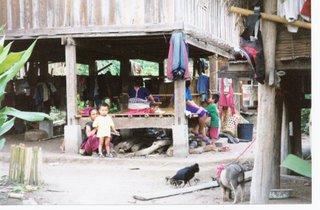
Parting thought: in the summer of 2002 I spent two months in Chiang Mai, Thailand. Living in the city, teaching English to college students, we met people who were mostly in the top ten percent of the country economically. Even so, we ate meals that cost only fifty cents each, standard fare for a full plate of rice, veggies, and some meat. Two weekends we traveled out to the rural villages to visit the people who work mostly as rice farmers. There the kids rarely get more than a third grade education and are lucky if they don't either go to jail for growing marijuana or become teenage prostitutes in the tourist areas in southern Thailand. Here's a picture of a typical family. We were some of the first Americans they saw and also some of the first Christians. What sort of message did we convey by showing up with all our digital cameras and multiple sets of clothes? Is that the Gospel? How could we have better represented Jesus to them?
Right now I'm reading a book by Shane Claiborne called The Irresistible Revolution. Shane is one of the founding members of a Philadelphia-based inner-city ministry/community called The Simple Way (http://www.thesimpleway.org). Fed up with the insulation of white Christian suburbia, Shane and some friends started going on regular trips to the inner city to have fellowship with a group of homeless families who lived in an abandoned church. Notice the choice of words there: they went for fellowship. The only mission they were on was to help protest the forced eviction of these families, but by taking on the literal role of Jesus in spending time in fellowship with them, they ended up falling in love with everyone there and making fellowship with those people a regular part of life. Eventually, they succeeded in preventing their eviction, with the help of several answers to prayer. The book conveys the power of the story much more than any summary I write can, so I certainly recommend it. What I can say, though, from having read a third of the book, is that I have been moved almost to tears several times while reading it because I see him doing ministry and making a difference in the world while I'm sitting here reading about it and "studying to do ministry".
Theology is important, no doubt, but there comes a point when scholarship insulates us from Jesus' calling in the same way that riches do. For example, take the difference between Matthew's version of the beatitudes and Luke's: "Blessed are the poor in spirit" vs. "Blessed are the poor." While I bet Jesus did mean to bless those who are grieving, mourning, and depressed, I've heard numerous people write off this blessing of the poor implying that Jesus only meant those who are poor in spirit. If we believe he only meant the poor in spirit, it's easy to start thinking that it's fine to be wealthy and miserly, all as long as we recognize that Christ meets us in our emotional sorrow.
That is, of course, a load of crap. But that's exactly what we feed ourselves when we start rationalizing away the brazenness of Jesus' message. This morning in Exegesis, Dr. Gagnon talked about how Jesus' words "Eat my flesh, drink my blood" were intentionally offensive because they were meant to call attention to his exclusive saving power. What do we do with that in church today? Call it symbolism and then forget what it symbolizes, namely the fact that Jesus' himself is The source of life.
So now I am left wishing that I was getting more real tangible experience in ministry right now - both to the poor in spirit and to the just plain poor. That is what my field education will provide in one aspect next year, but since I'll be working at a fairly well-off suburban church, I'll surely still be wrestling with these distinctions. Until then, I still admit that I'm not living up to Christ's calling here - I only pray that God will have mercy upon me until I actually do.
Parting thought: in the summer of 2002 I spent two months in Chiang Mai, Thailand. Living in the city, teaching English to college students, we met people who were mostly in the top ten percent of the country economically. Even so, we ate meals that cost only fifty cents each, standard fare for a full plate of rice, veggies, and some meat. Two weekends we traveled out to the rural villages to visit the people who work mostly as rice farmers. There the kids rarely get more than a third grade education and are lucky if they don't either go to jail for growing marijuana or become teenage prostitutes in the tourist areas in southern Thailand. Here's a picture of a typical family. We were some of the first Americans they saw and also some of the first Christians. What sort of message did we convey by showing up with all our digital cameras and multiple sets of clothes? Is that the Gospel? How could we have better represented Jesus to them?
Friday, March 31, 2006
More Thoughts on Apostolic Poverty
My good friend Jimmy from Colorado posted a very thoughtful response to my last post, which leads to this revision/continuance of what I had talked about. To view his post, just scroll down and click on the comments to my last one. In summary, Jimmy made some great points about 1) how the parable of the talents in Matthew 25 suggests that what we do with our money matters more than what we have, 2) how Richard Foster wrote in "Celebration of Discipline" that God doesn't want us to be either rich or poor (because the extremely poor can be just as preoccupied with money as the wealthy), 3) and the education of Paul is evidence that he came from a wealthy background. I'm sure that all of these ideas are true, but I still think we need to add a couple qualifications to them. While I think Jimmy is exactly right that God gives us economic blessings so that we may be blessings to others, I think there are subtle ways in which we often fail to use that money appropriately.
First think about it this way: in order to have wealth, you have to acquire it. Regardless of what one does with his/her money, doesn't God also care about how that person got the money? Check out Deuteronomy 23:18: "You must not bring the earnings of a female prostitute or of a male prostitute into the house of the LORD your God to pay any vow, because the LORD your God detests them both." (NIV). Obviously prostitution was then and is now considered to be immoral and offensive to God's design of sexuality, hence profits made from that were not acceptable to God even if someone tried to present them as an offering to God. Now let's apply this to today's business world. Of course there are many perfectly honest companies and executives out there, but we know there are just as many who are not perfectly honest or faultless in their business ethics. If it is acceptable in God's sight to possess wealth, does that hold true for people who made their money in the tobacco industry? Or the pornography industry? Or drugs? I have a feeling God detests those products like God detests prostitution. So what about companies that are economically immoral? Most people agree that sweatshops amount to cruel treatment of the workers. Would God approve of the wealth possessed by a person who made his/her money by marketing merchandise made in sweatshops? Furthermore, does God approve of us buying clothes that are made in sweatshops because we want to save the extra money to include in our tithe at church? The lines there are getting pretty blurry.
This leads to the second point: even if we received our wealth justly and honestly as a blessing from God, are there moral implications for how we go about preserving that wealth? Let's use coffee as the example now. "Fair Trade" coffee hit the market after people read horror stories about the way workers on coffee plantations in Africa and South America were abused and not even paid enough to live on. (For more info, see http://www.globalexchange.org/campaigns/fairtrade/coffee/). If my need for caffeine forces me to buy cheap coffee and thus perpetuate the degradation of a worker in a third-world country, does God approve of that? I don't think so. What if I need the coffee to stay awake to study for my seminary classes? I still don't think God would approve. One of the core themes in the Old Testament Prophets is that economic exploitation is dishonoring to God. Therefore, while it may have been acceptable in God's eyes then for people to possess some degree of wealth (the kings of Israel?), it wasn't acceptable if that meant the oppression of others. Here is one final example that carries this idea one step further: God created the earth and said that it was good, and even though God gave us dominion over the earth, he probably didn't intend for that dominion to lead destruction of his good Creation. When we buy food that was grown using pesticides that pollute the ground, we are polluting God's Creation. When we buy other products that are made in a manner that demeans Creation, such as non-recycled/recyclable materials or gas-hogging vehicles, we are also polluting God's good Creation. And why do we do these things? Because we love our money too much to pay the premium for a hybrid car or organic food. And of course this doesn't even scratch the surface on the even larger issue of moral investment/divestment. If we put our savings in mutual funds or stocks that include companies that are unethical in their business practices, are we too not responsible for their sin? When Sharon Watkins, the Enron "whistle-blower", gave a guest lecture here at Pittsburgh Seminary last Fall, she mentioned the fact that responsible investment is one of the only ways to hold unethical companies like Enron responsible. If we divest the savings we have in immoral companies and instead invest them in socially-responsible companies, we send the powerful message to business executives that we value people and morals more than just money and interest.
I write all these things realizing that I am far from perfect in living up to these standards. Most of the ideas I listed above are ones that I am only now beginning to explore in terms of actually making a difference in the way I live. But that is what it means to repent - when we realize we are in sin, we repent, turning the other direction and making a difference in our lives. In sharing these thoughts, I guess I am initiating the repentance process for myself, which for now may just be a heightened awareness of the impact my decisions make. The more people there are who have the awareness, though, the more people who will make a change in their lives, and that has the power to change our society.
Holy Lord God, please help us, though we fail to live up to Your perfection, to at least live in a way that pushes us ever closer to You. Forgive us our oppression of others, and grant us the ability to see the economic decisions we make through Your eyes. If You bless us with wealth, guide us by the power of the Holy Spirit to show us how to manage and use that wealth as You alone see fit. Amen.
First think about it this way: in order to have wealth, you have to acquire it. Regardless of what one does with his/her money, doesn't God also care about how that person got the money? Check out Deuteronomy 23:18: "You must not bring the earnings of a female prostitute or of a male prostitute into the house of the LORD your God to pay any vow, because the LORD your God detests them both." (NIV). Obviously prostitution was then and is now considered to be immoral and offensive to God's design of sexuality, hence profits made from that were not acceptable to God even if someone tried to present them as an offering to God. Now let's apply this to today's business world. Of course there are many perfectly honest companies and executives out there, but we know there are just as many who are not perfectly honest or faultless in their business ethics. If it is acceptable in God's sight to possess wealth, does that hold true for people who made their money in the tobacco industry? Or the pornography industry? Or drugs? I have a feeling God detests those products like God detests prostitution. So what about companies that are economically immoral? Most people agree that sweatshops amount to cruel treatment of the workers. Would God approve of the wealth possessed by a person who made his/her money by marketing merchandise made in sweatshops? Furthermore, does God approve of us buying clothes that are made in sweatshops because we want to save the extra money to include in our tithe at church? The lines there are getting pretty blurry.
This leads to the second point: even if we received our wealth justly and honestly as a blessing from God, are there moral implications for how we go about preserving that wealth? Let's use coffee as the example now. "Fair Trade" coffee hit the market after people read horror stories about the way workers on coffee plantations in Africa and South America were abused and not even paid enough to live on. (For more info, see http://www.globalexchange.org/campaigns/fairtrade/coffee/). If my need for caffeine forces me to buy cheap coffee and thus perpetuate the degradation of a worker in a third-world country, does God approve of that? I don't think so. What if I need the coffee to stay awake to study for my seminary classes? I still don't think God would approve. One of the core themes in the Old Testament Prophets is that economic exploitation is dishonoring to God. Therefore, while it may have been acceptable in God's eyes then for people to possess some degree of wealth (the kings of Israel?), it wasn't acceptable if that meant the oppression of others. Here is one final example that carries this idea one step further: God created the earth and said that it was good, and even though God gave us dominion over the earth, he probably didn't intend for that dominion to lead destruction of his good Creation. When we buy food that was grown using pesticides that pollute the ground, we are polluting God's Creation. When we buy other products that are made in a manner that demeans Creation, such as non-recycled/recyclable materials or gas-hogging vehicles, we are also polluting God's good Creation. And why do we do these things? Because we love our money too much to pay the premium for a hybrid car or organic food. And of course this doesn't even scratch the surface on the even larger issue of moral investment/divestment. If we put our savings in mutual funds or stocks that include companies that are unethical in their business practices, are we too not responsible for their sin? When Sharon Watkins, the Enron "whistle-blower", gave a guest lecture here at Pittsburgh Seminary last Fall, she mentioned the fact that responsible investment is one of the only ways to hold unethical companies like Enron responsible. If we divest the savings we have in immoral companies and instead invest them in socially-responsible companies, we send the powerful message to business executives that we value people and morals more than just money and interest.
I write all these things realizing that I am far from perfect in living up to these standards. Most of the ideas I listed above are ones that I am only now beginning to explore in terms of actually making a difference in the way I live. But that is what it means to repent - when we realize we are in sin, we repent, turning the other direction and making a difference in our lives. In sharing these thoughts, I guess I am initiating the repentance process for myself, which for now may just be a heightened awareness of the impact my decisions make. The more people there are who have the awareness, though, the more people who will make a change in their lives, and that has the power to change our society.
Holy Lord God, please help us, though we fail to live up to Your perfection, to at least live in a way that pushes us ever closer to You. Forgive us our oppression of others, and grant us the ability to see the economic decisions we make through Your eyes. If You bless us with wealth, guide us by the power of the Holy Spirit to show us how to manage and use that wealth as You alone see fit. Amen.
Tuesday, March 28, 2006
Thoughts on Apostolic Poverty
"Rich or poor, God I want You more than anything that glitters in this world. Be my all, all consuming fire." - Charlie Hall, All We Need -
Rich or poor. Emphasis on poor. On the phone tonight I had a chance to catch up with my best friend from college who told me about his recent feelings of conviction about his own selfishness and materialism. Providentially, since getting married and moving to Pittsburgh, Eileen and I have tried to live our life here together in a non-materialistic way. Tried because we have not always succeeded - a la the deluxe coffee table we have courtesy of Eileen's parents. But there have been some successes. For example, as I'm typing this, I'm wearing a shirt I bought at a thrift store and pants given to me by a friend. Beans and rice were lunch today. And after paying the copay at a doctor's office today I was left with a grand total of ninety-five cents in my checking account.
At the beginning of the semester Professor Scott Sunquist frequently reminded our Church History 1 class about the continual importance of apostolic poverty for the early leaders of the church. Athanasius, St. Patrick, Columbanus, and many more boldly set the examples for what poverty meant in conjunction with the Gospel. At the same time as I was hearing this in class, Eileen and I were getting involved at The Open Door - the most unpretentious and genuine church I've ever attended. The sermons may not make a big deal about it, but it is obvious from the fact that we meet in a cold and drafty old church building currently under renovation that the community of The Open Door embodies more genuinely the virtues of apostolic poverty than any other non-monastic church I know. Add to that the connection with the intentional communities associated with the people of the Open Door who move into the poorer parts of the city for the sake of setting a Christ-like example for their neighbors. Perhaps that community is more sensitive to the riches of poverty because of their own personal experience as well: as a tangible reminder to pray for the concerns of people in the community at church a couple weeks ago, people were invited to write their personal prayer concerns on a rock which would then be taken home by another person who would commit to pray for that concern and person. Right now I'm looking at a rock that reads "failure, poverty, and debt". I can relate to the debt - I graduated college with credit card debt and no job, and that debt was eventually only relieved by the generous wedding gifts we were given.
Perhaps this is why "debt" in the Calvinist tradition is so often used as a metaphor for sin: it is a pit we simply can't get out of on our own. And just as in realizing our spiritual poverty we are forced to come to God for His gracious cancellation of our debts, our physical poverty in this life serves as a tangible reminder of our ever-present need to depend upon the Lord.
So where does this lead? To the lyrics of Derek Webb's song, Rich Young Ruler. (http://www.derekwebb.com)
"Poverty is so hard to see when it’s only on your tv and twenty miles across town,
where we’re all living so good that we moved out of Jesus’ neighborhood,
where he’s hungry and not feeling so good from going through our trash.
He says, 'More than just your cash and coin I want your time, I want your voice. I want the things you just can’t give me.'
So what must we do? Here in the west we want to follow You.
We speak the language and we keep all the rules (even a few we made up).
'Come on and follow me, but sell your house, sell your SUV, sell your stocks, sell your security
and give it to the poor.'
'What is this, hey what’s the deal? I don’t sleep around and I don’t steal.'
'But I want the things you just can’t give me.
Because what you do to the least of these my brother’s, you have done it to me
because I want the things you just can’t give me.'"
May God grant us the grace and ability to live up to what these words suggest.
Rich or poor. Emphasis on poor. On the phone tonight I had a chance to catch up with my best friend from college who told me about his recent feelings of conviction about his own selfishness and materialism. Providentially, since getting married and moving to Pittsburgh, Eileen and I have tried to live our life here together in a non-materialistic way. Tried because we have not always succeeded - a la the deluxe coffee table we have courtesy of Eileen's parents. But there have been some successes. For example, as I'm typing this, I'm wearing a shirt I bought at a thrift store and pants given to me by a friend. Beans and rice were lunch today. And after paying the copay at a doctor's office today I was left with a grand total of ninety-five cents in my checking account.
At the beginning of the semester Professor Scott Sunquist frequently reminded our Church History 1 class about the continual importance of apostolic poverty for the early leaders of the church. Athanasius, St. Patrick, Columbanus, and many more boldly set the examples for what poverty meant in conjunction with the Gospel. At the same time as I was hearing this in class, Eileen and I were getting involved at The Open Door - the most unpretentious and genuine church I've ever attended. The sermons may not make a big deal about it, but it is obvious from the fact that we meet in a cold and drafty old church building currently under renovation that the community of The Open Door embodies more genuinely the virtues of apostolic poverty than any other non-monastic church I know. Add to that the connection with the intentional communities associated with the people of the Open Door who move into the poorer parts of the city for the sake of setting a Christ-like example for their neighbors. Perhaps that community is more sensitive to the riches of poverty because of their own personal experience as well: as a tangible reminder to pray for the concerns of people in the community at church a couple weeks ago, people were invited to write their personal prayer concerns on a rock which would then be taken home by another person who would commit to pray for that concern and person. Right now I'm looking at a rock that reads "failure, poverty, and debt". I can relate to the debt - I graduated college with credit card debt and no job, and that debt was eventually only relieved by the generous wedding gifts we were given.
Perhaps this is why "debt" in the Calvinist tradition is so often used as a metaphor for sin: it is a pit we simply can't get out of on our own. And just as in realizing our spiritual poverty we are forced to come to God for His gracious cancellation of our debts, our physical poverty in this life serves as a tangible reminder of our ever-present need to depend upon the Lord.
So where does this lead? To the lyrics of Derek Webb's song, Rich Young Ruler. (http://www.derekwebb.com)
"Poverty is so hard to see when it’s only on your tv and twenty miles across town,
where we’re all living so good that we moved out of Jesus’ neighborhood,
where he’s hungry and not feeling so good from going through our trash.
He says, 'More than just your cash and coin I want your time, I want your voice. I want the things you just can’t give me.'
So what must we do? Here in the west we want to follow You.
We speak the language and we keep all the rules (even a few we made up).
'Come on and follow me, but sell your house, sell your SUV, sell your stocks, sell your security
and give it to the poor.'
'What is this, hey what’s the deal? I don’t sleep around and I don’t steal.'
'But I want the things you just can’t give me.
Because what you do to the least of these my brother’s, you have done it to me
because I want the things you just can’t give me.'"
May God grant us the grace and ability to live up to what these words suggest.
Monday, March 20, 2006
This morning I read some words of Jesus that really struck home for me. In Mark 10:29-30 (NASB) , Jesus says, “Truly I say to you, there is no one who has left house or brothers or sisters or mother or father or children or farms, for My sake and for the gospel’s sake, but that he will receive a hundred times as much now in the present age, houses and brothers and sisters and mothers and children and farms, along with persecutions; and in the age to come, eternal life.” To come to Pittsburgh, Eileen and I left behind all the friends we'd made in Boulder, CO, and our families in Colorado, Chicago, and Phoenix to come here so I could attend Pittsburgh Theological Seminary. At the time I didn't think the distance from friends afamilyliy would affect me much - I seemed to believe that emotional attachments like that didn't have as big an effect on me. Eileen took it harder, and even though she's done a better job of keeping in touch with friends in Colorado, she still misses Boulder even more than I do.
Yet now we are anything but lonely here in Pittsburgh, and this past weekend testifies to how much our new family here has grown. Friday we had a St. Patrick's Day party with friends from the seminary, the Open Door, and others, and we were blessed by the presence of every one of them in our apartment that evening. Saturday night BJ and Katrina Woodworth welcomed us to their house to hang out and chat, graciously including us in their family's birthday festivities for BJ. Then last night at the Open Door, it really sank in how much the community there has become an essential part of our lives. As John Creasy preached about how we have been "adopted" into the family of God, I saw how that process becomes tangible in the new church communities we join.
Jesus is faithful, and his words are true. Of course that shouldn't be a surprise, but it can be surprising at times to read in the Gospels something Jesus taught two-thousand years ago, and suddenly have it dawn on you how true it is in your own life. Praise be to God for the families we've been blessed with both at home and here in Pittsburgh. May God grant us the ability to continually live as a part of God's family: "Jesus said to them, 'My mother and My brothers are these who hear the word of God and do it.'" (Luke 8:21). Amen.
Yet now we are anything but lonely here in Pittsburgh, and this past weekend testifies to how much our new family here has grown. Friday we had a St. Patrick's Day party with friends from the seminary, the Open Door, and others, and we were blessed by the presence of every one of them in our apartment that evening. Saturday night BJ and Katrina Woodworth welcomed us to their house to hang out and chat, graciously including us in their family's birthday festivities for BJ. Then last night at the Open Door, it really sank in how much the community there has become an essential part of our lives. As John Creasy preached about how we have been "adopted" into the family of God, I saw how that process becomes tangible in the new church communities we join.
Jesus is faithful, and his words are true. Of course that shouldn't be a surprise, but it can be surprising at times to read in the Gospels something Jesus taught two-thousand years ago, and suddenly have it dawn on you how true it is in your own life. Praise be to God for the families we've been blessed with both at home and here in Pittsburgh. May God grant us the ability to continually live as a part of God's family: "Jesus said to them, 'My mother and My brothers are these who hear the word of God and do it.'" (Luke 8:21). Amen.
Monday, March 06, 2006


Subscribe to:
Posts (Atom)
